Hiroshi Nanami: The maestro who redefined Japanese football
Hiroshi Nanami, a visionary maestro of the J.League's golden era, utilized his sublime left foot like a compass, guiding Júbilo Iwata and the Samurai Blue to historic heights. In an age when modern football began to obsess over distance covered and pure physical power, Nanami stood as a serene, brilliant antithesis. He was a playmaker who did not need to run aimlessly; instead, he could control the entire pitch with a single, casual swing of his left foot. As the undisputed metronome of Júbilo Iwata and the iconic number 10 of the Japan national team, his elegance shaped a golden age of Japanese football.
Born on November 28, 1972, in Fujieda, Shizuoka Prefecture, Nanami's destiny was carved out on the pitch from an early age. Fujieda was a city where football was treated with immense reverence, and youth players were expected to possess immaculate technique. He honed his craft at the prestigious Shimizu Shogyo High School, a legendary academy that produced some of the country’s finest technical players, before refining his game at Juntendo University.
In 1995, the promising midfielder officially signed with Júbilo Iwata, immediately establishing himself as a permanent fixture in a star-studded starting eleven. His rookie season was explosive, as he brought a rare, calculated calm to a league often frantic and chaotic. Operating as a deep-lying playmaker, he possessed a maturity that defied his youth, consistently picking out defense-splitting passes with millimeter precision.
His sublime left foot did not escape the attention of Italian legend Salvatore "Totò" Schillaci, who shared the dressing room with Nanami at Júbilo Iwata and praised him to the Italian press: "Here in Japan he is one of the best. He does everything with his left. His specialties are assists and free kicks, then: implacable. He reminds me of Giuseppe Giannini."
Between 1996 and 1998, Nanami became the undisputed heartbeat of Júbilo Iwata, leading them to a J1 League title, a J.League Cup, and the prestigious Asian Club Championship. His domestic dominance was absolute, earning him three consecutive J.League Best Eleven selections and cementing his status as the nation's premier midfielder. On the international stage, he famously inherited Japan’s heavy number 10 shirt, orchestrating the nation’s historic first-ever qualification for the FIFA World Cup in 1998.
At the World Cup in France, Nanami played every single minute in Group H, going head-to-head with legendary global superstars. He fought valiantly in the midfield against Juan Sebastián Verón and Javier Zanetti in a narrow 1-0 defeat to Argentina, before battling Croatia’s Aljoša Asanović and Robert Prosinečki in Nantes. Against Jamaica in Lyon, his creative passing helped unlock the defense, allowing his teammate Masashi "Gon" Nakayama to score Japan's historic first-ever goal on the World Cup stage.
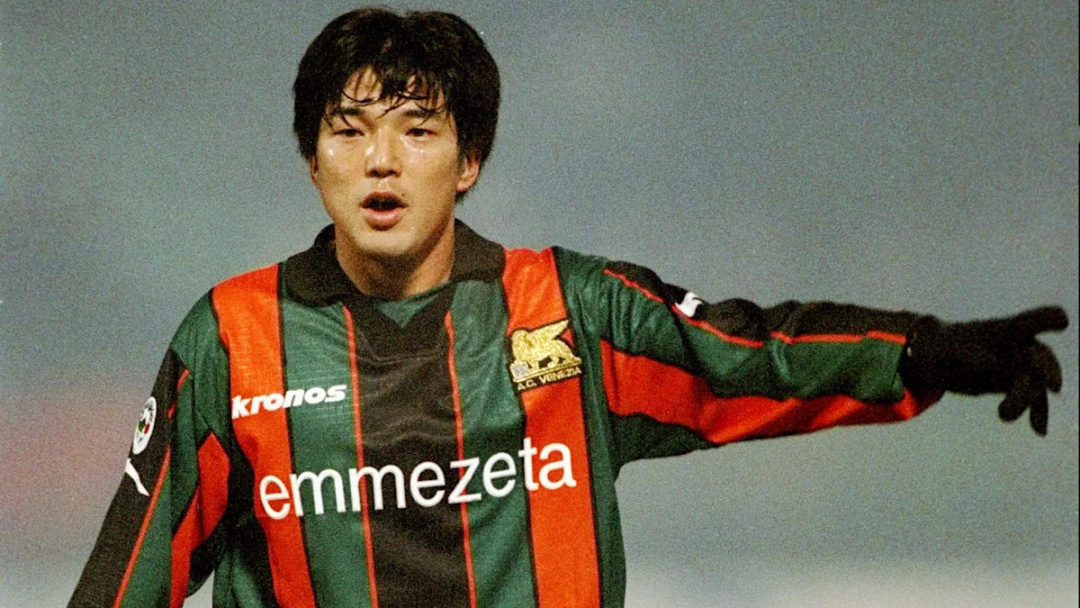
By the summer of 1999, European scouts were enamored with Nanami's sublime technical style. Serie A club Venezia FC, looking for a worthy replacement for Álvaro Recoba, signed Nanami on a high-profile loan deal. Venetian club president Maurizio Zamparini proudly introduced his new Japanese star to the Italian media with grand expectations: "Nanami has the same class as Recoba."
Nanami’s time in the floating city was a challenging battle against a highly physical, defensive Italian league, resulting in just one goal (scored against Udinese) in 24 appearances as Venezia suffered relegation. Yet, the Shizuoka maestro chose to view his Italian adventure through a lens of gratitude rather than disappointment. Upon his return to Iwata in late 2000, he reflected: "An experience in Italy is more important than money."
Nanami's pivotal role in Japan's success
Upon returning home, Nanami reached his career peak at the 2000 AFC Asian Cup in Lebanon. Playing every single minute of the tournament, he scored three crucial goals, guided Japan to a spectacular championship, and was rightfully crowned the tournament's Most Valuable Player (MVP).
This continental triumph set the stage for Júbilo Iwata's most legendary tactical experiment in 2001: the revolutionary "N-Box" formation. Conceived by manager Masakazu Suzuki to shorten running distances and maximize possession, the system placed five midfielders in a tight die-like "five" pattern, with Nanami at the absolute center. Flanked by Toshiya Fujita, Daisuke Oku, Takashi Fukunishi, and Toshihiro Hattori, this setup allowed them to pass the ball at dizzying, high speeds.
Reflecting on the sheer difficulty and ultimate genius of the system, former teammate Takashi Fukunishi revealed: "At first, everyone said it was impossible during training camp... it was always crowded where Nanami was, but because he was there, we could possess the ball anywhere."
The relentless physical demands of elite football eventually caught up with the elegant playmaker. In 2001, Nanami suffered a severe knee injury that effectively ended his international career after 67 caps and 9 goals. The injury robbed him of his sharpness, forcing him to rely entirely on his positioning and spatial awareness to survive on the pitch. Though he returned to help Júbilo Iwata capture another J1 League title in 2002 and the Emperor's Cup in 2003, his physical capabilities were permanently compromised.
He spent his final years searching for the old magic on brief loans at Cerezo Osaka and Tokyo Verdy, before returning to Júbilo Iwata for one last emotional chapter. In November 2008, dogged by chronic knee pain and realizing he could no longer perform at his own high standards, Nanami officially announced his retirement.
After hanging up his boots, Nanami naturally transitioned to the dugout, bringing his immense tactical intellect to the managerial realm. He returned to save his beloved Júbilo Iwata as manager in September 2014, successfully guiding them back to the J1 League in 2015. He also had a managerial stint with Matsumoto Yamaga before taking on his current, prestigious role as an assistant coach for the Japan national team under Hajime Moriyasu.
What the Scoreboard Won't Tell You
His tactical acumen and emphasis on elite, world-class standards continue to shape the next generation of Japanese stars. National team midfielder Daichi Kamada recently shared how Nanami’s modern coaching methods have elevated their play: "Mr. Nanami showed us videos of how the world's top players dribble past defenders and the timing of their shots, so we can progress further... Since Mr. Nanami has pointed it out, I think everyone can be more conscious about achieving it."
Hiroshi Nanami’s legacy is not just one of trophies, but of a rare, artistic footballing philosophy. In an era that increasingly prioritizes physical metrics and athletic power, he remains a legendary symbol of how a beautiful mind and a golden left foot can command the beautiful game.